Pinning each character to one picture stopped them wandering between panels. It also exposed the question I’d been quietly dodging: that picture has to show something, and somebody has to decide what. A face doesn’t get drawn first. It gets written down first — down to the number of arms.

The assumption
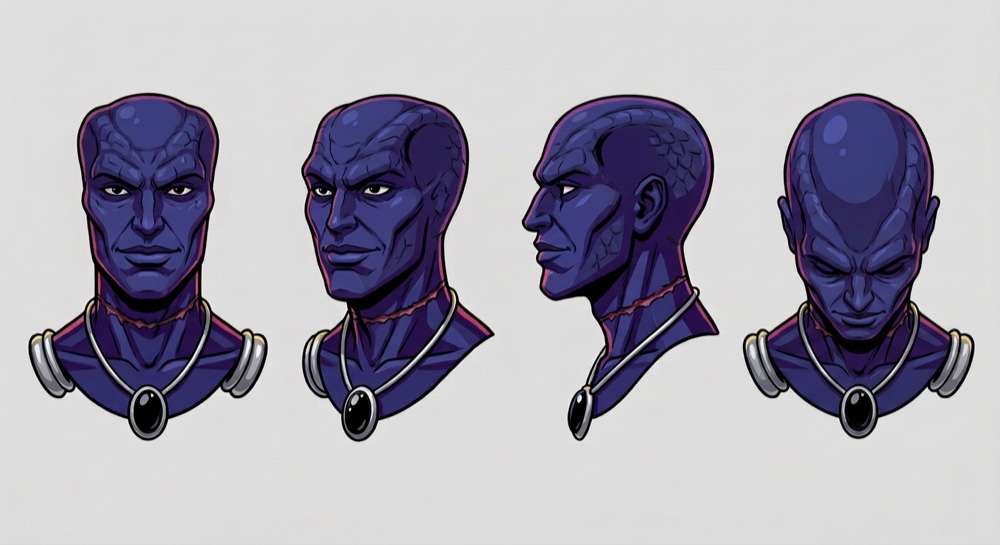
I assumed the source material had already done this job for me. These are characters people have been depicting for centuries — a god with four arms, a serpent with seven heads, a head that floats with no body under it. Ask for a picture and you get one. The look felt like something you retrieve, not something you choose.
So the earliest character art was asked for the way you’d describe someone to a friend: a name, a sentence, a mood. What came back was fine. It was fine every single time, and fine in a slightly different way every single time.
Where it broke
A sentence is not a specification.
“Four-armed” doesn’t say what’s in the four hands. “An elder” doesn’t say how old — sixty and seventy-five are two different people. “Wears gold” doesn’t say gold where. Every gap in a description gets filled by whoever is drawing, and an unfilled gap is filled differently each time it comes up.
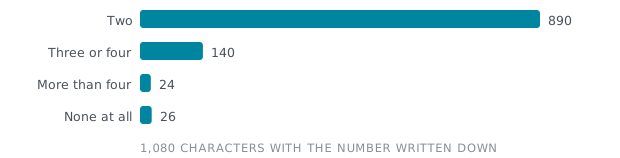
And the cast stops being humanoid fast. Twenty-six of the characters written down so far have no arms at all: serpents whose coiled body is the whole performance, a mountain, a poison sitting in a vessel. “Draw them consistently” means nothing until somebody has said what them is.
The insight
So a character’s look stopped being something to ask for and became something to decide — in advance, in writing, one character at a time. Not a description of them. A set of standing rules about them.
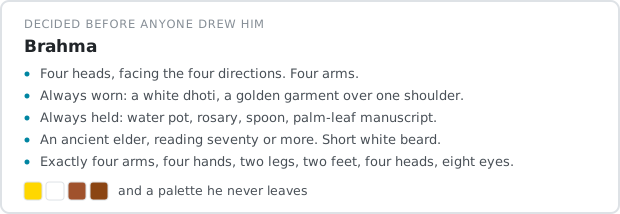
Written this way, the last line is the one that changed how I think about it: an exact count of arms, hands, legs, heads and eyes. It reads like paperwork right up until you notice it’s the only part of a character’s look that can be settled by counting.
What it looks like now
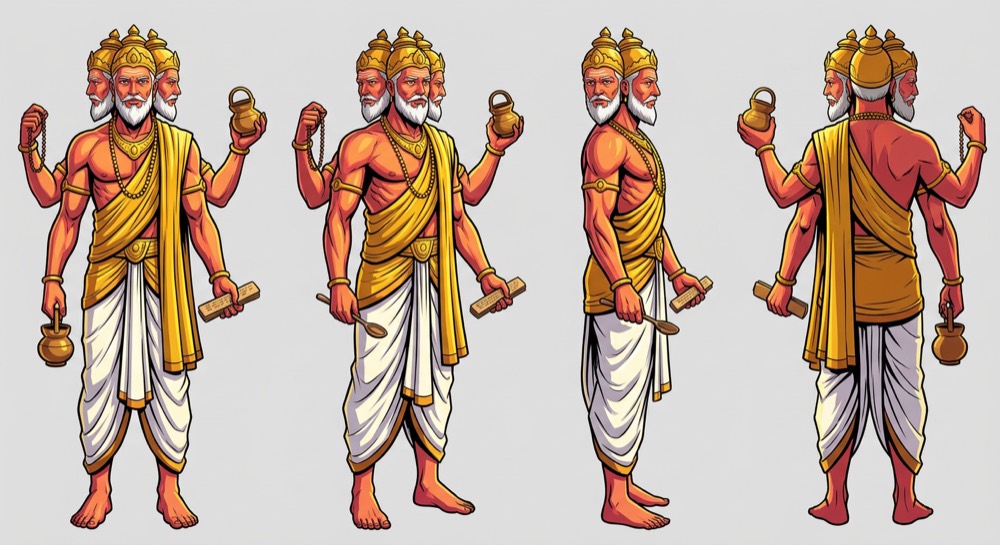
No character has a picture without a written identity sitting behind it. And because the rules are countable, the picture can be read back against them, line by line: four heads, four arms, white cloth below, gold over one shoulder, a water pot, a rosary, a spoon, a palm-leaf manuscript, a short white beard. Not luck. The list.
 Four heads, four arms
 A head, and nothing else
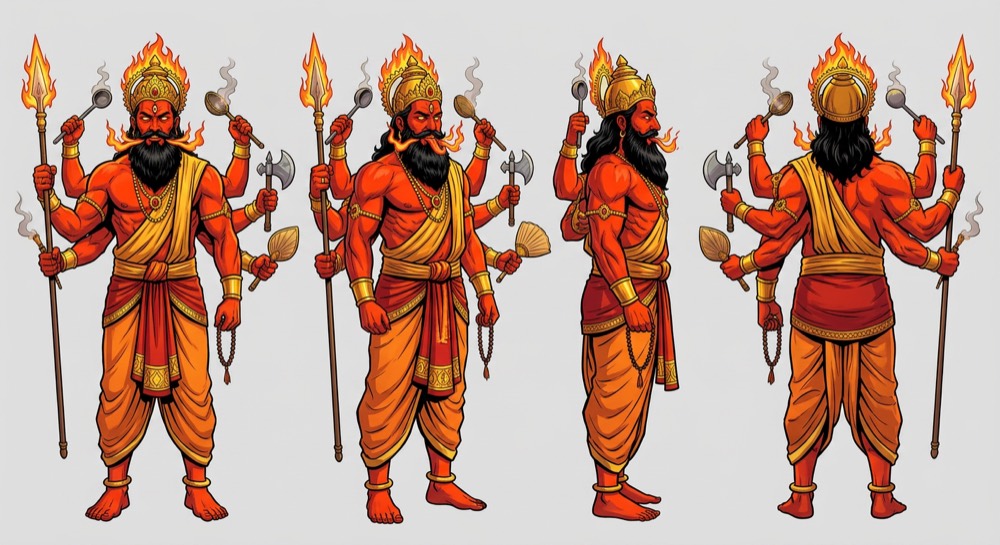 An arm for every implement
The rules reach further than I expected, too. Two characters are written as having a thousand arms, and one of those entries doesn’t stop at the count: show all thousand in a wide shot, at least fifty in a mid shot, the dominant six to eight in close-up. Somebody had to sit down and decide that.
Which is the part I’d have argued with a month earlier. I thought consistent was a quality you earn by being careful, the way a careful illustrator stays on model. It isn’t. Consistency is a by-product of having decided — a character who looks the same in every panel is just a character somebody made a decision about, once, in words, before any picture existed. All the care lives in the deciding. After that, staying on model is the easy part.
Update log
- 2026-08-22 — Post #6. Written after going back through the cast: every character with art has a written identity behind it, and 1,080 of those identities pin down an exact number of arms.