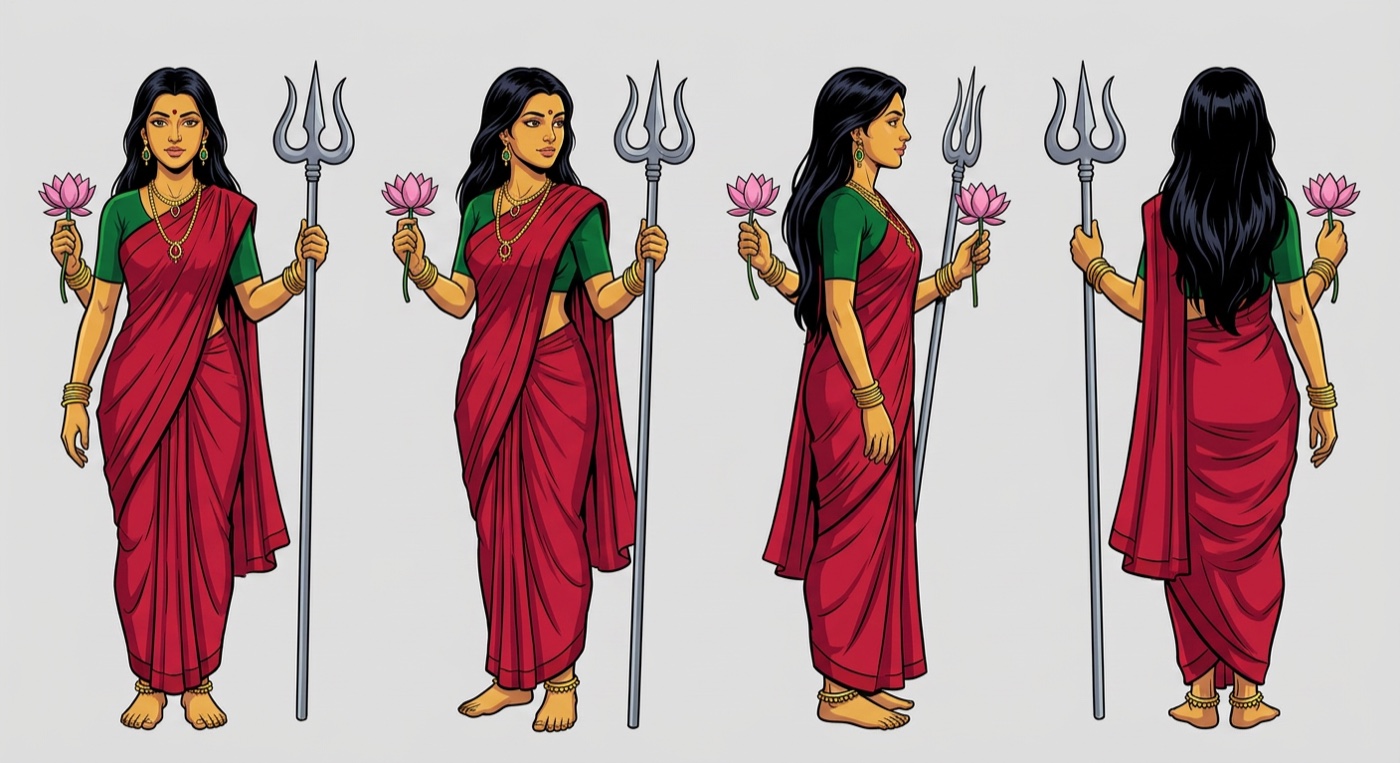
A character’s look is settled in writing now — the standing rules, the exact count of arms and heads — and one picture is drawn to that specification for everything else to follow. Which makes that picture the one thing in the chain nobody checks. What if it’s wrong? About a third of ours were. And when we started correcting them, the interesting finding wasn’t that correction works. It’s that it works exactly once.

The assumption
The reference sheet was the fixed point. Everything downstream got measured against it, which quietly made it the one thing nobody measured.
The habit that produced it was: write down who this character is, ask for a drawing of that, look at what comes back, nod, move on. Looking is a weak test. A sheet can be well drawn, correctly costumed, unmistakably the right person — and still be wrong in the exact detail the description was specific about.
Where it broke
The mismatches were never bad art. They were small, confident, specific contradictions.
Silver armbands drawn onto the forearms, where the description asked for both upper arms. A mustache on a character written with none. A figure standing where the description said seated. An elephant drawn with a single head, for a character described as having several.
Not one of those looks like an error. Each looks like a picture.
And a wrong anchor doesn’t produce one wrong drawing. It produces a consistently wrong character — every panel faithfully reproducing the same mistake, because faithful reproduction is the entire point of anchoring. The better the anchor holds, the further the error travels.
Of 134 characters put through a review, 87 matched their description first time. Forty-seven didn’t.
The insight
The fix wasn’t a better eye. It was a better question.
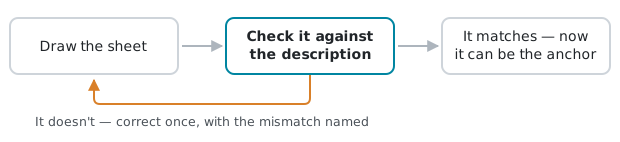
“Is this good?” has no answer you can act on. “Does this match what we wrote?” does: read the description back, list every place the picture contradicts it, and say plainly whether it passes. That turns a correction from redraw this, better into the armbands go on the upper arms — a change with a target.
Then the numbers did something we didn’t expect. Of the forty-seven that failed, thirty-three went on to at least one correction pass:
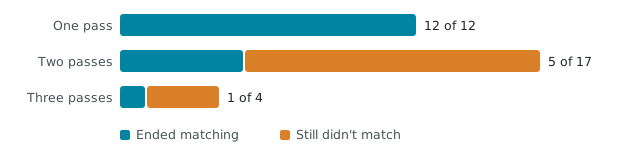
One pass rescued twelve out of twelve. A second rescued five of seventeen. A third, one of four.
That gap is two different kinds of wrong wearing the same verdict. One is a detail the drawing got wrong, and naming it is enough. The other is something that cannot be drawn at all — a serpent described with a thousand heads and two thousand eyes came back with twenty-six, and four rounds later was still failing. Extra rounds don’t tell those apart. They just spend effort on the second kind while looking exactly like progress.
What it looks like now
Draw, check against what was written, correct once with the mismatch named, check again. What survives that is the anchor. What doesn’t gets a failure on the record rather than a silent promotion — and it’s read as a fact about the description, not the drawing. A thousand heads is a writing problem.
A hundred and three of the 134 characters now match what we said about them, up from 87 on the first attempt. The rest are known, which is the part that matters. Because the lesson generalises well past pictures: the moment you make one artifact the thing everything else is measured against, you’ve made it the one artifact with nothing measuring it. Anchors need a check of their own, and it has to run against something written down rather than against how it looks. We thought we were adding a repair step. What we actually got was a way to find out which mistakes are worth repairing.
Update log
- 2026-08-23 — Post #7. There’s no before-and-after picture here on purpose: a corrected sheet is written over the old one, so the earlier versions genuinely don’t exist any more. What survives is the trail of verdicts, which is what the chart is drawn from.