Panels were finally coming back drawn, and one at a time they looked good. Put them side by side and the story fell apart: a character was not the same character from one panel to the next. Nothing about how he was described had changed between them. The description was never the problem.

The assumption
I assumed a character was something words could pin down. The panel direction already named who was in shot and said what they looked like — a serene, four-headed elder, ancient and wise. Say that again for the next panel and you should get him again.
Same description in, same person out. That’s how everything upstream had behaved, so I never thought about it.
Where it broke
Panels are drawn one at a time, independently. Nothing carries over. The drawing step has no memory of the panel before it — each one begins from an empty frame and a paragraph of text.
And a description isn’t an identity. It’s a filter. “An ancient elder with a white beard, a golden crown and four faces” doesn’t name one person; it names a category with an enormous number of members, and each panel picks a different member — legitimately, because every one of them fits the words. Pile on adjectives and you narrow the category. You never narrow it to one.
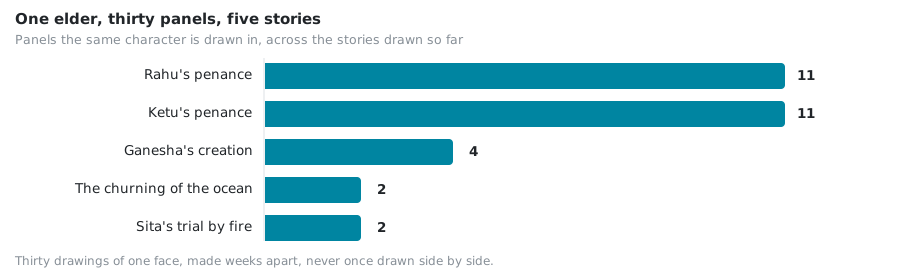
That would be survivable if characters appeared once. They don’t. One figure is drawn thirty times across five separate stories in what’s been made so far — and no two of those drawings were ever made in each other’s company.
The insight
You cannot describe a face precisely enough. You can only show it.
So each character got one picture of their own: a plain sheet, the figure drawn from four sides against an empty grey background, nothing else in frame. It is not a panel and it never appears in a comic. Its only job is to be the answer to who is this?
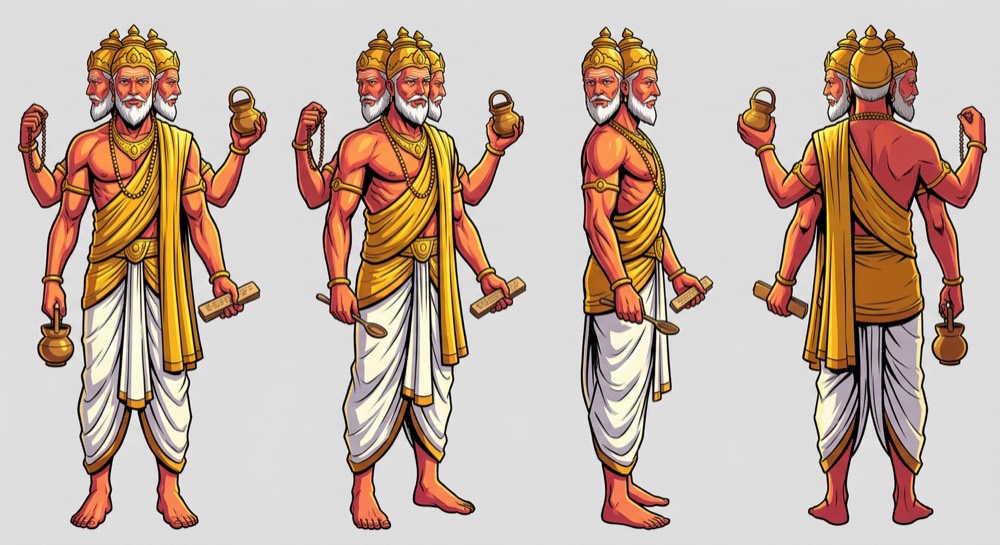
That picture is where identity now lives. The words didn’t go away, they got demoted: the sentence says what the character is doing in this panel, the picture says who is doing it. Description was being asked to do a job it is structurally bad at, and no amount of extra detail was going to fix that — because the problem was never that the description was vague. It was that a description, however precise, is satisfied by many faces.
What it looks like now
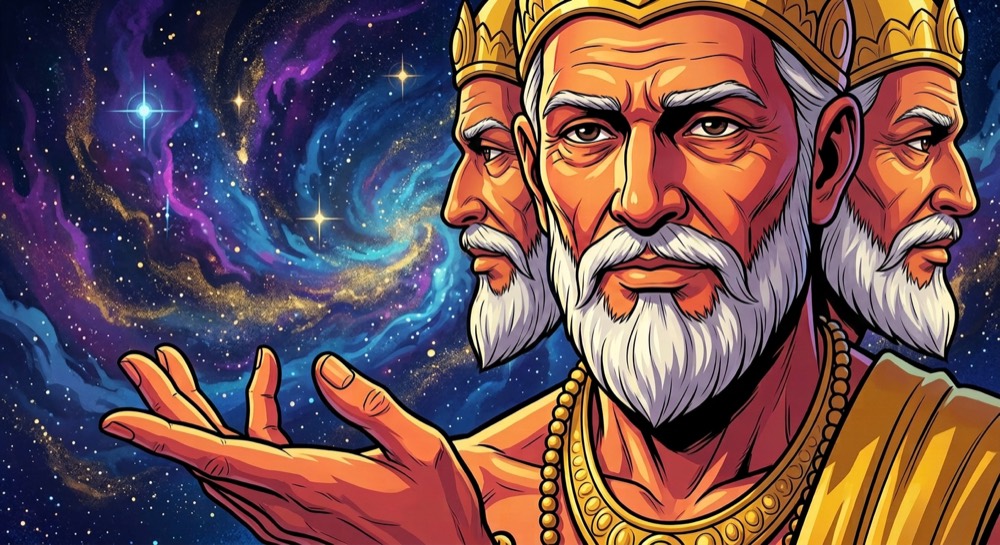
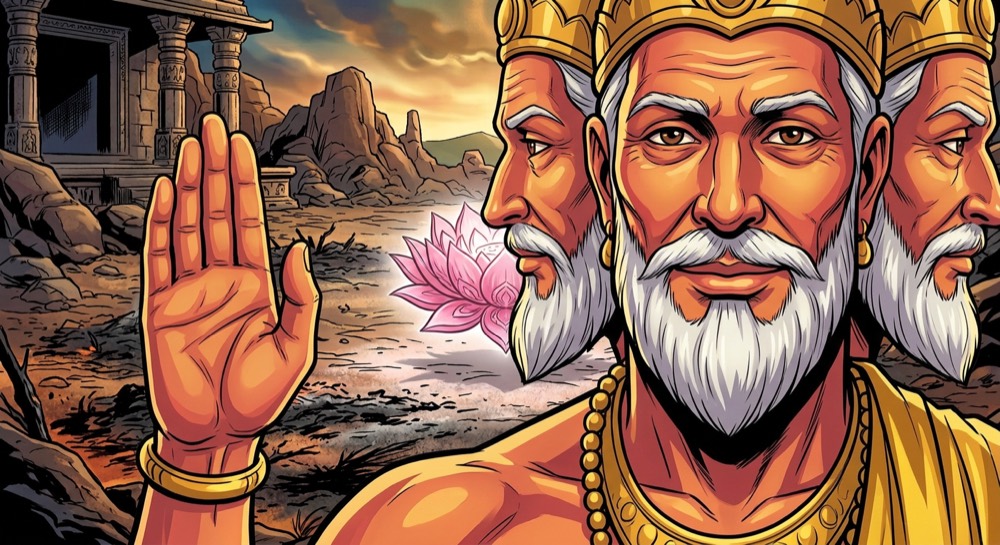
Every panel carries a small cast list: who is in shot. When the panel is drawn, each named character’s picture travels with it, tied to that character by name so the right face lands on the right figure. Panel three and panel thirty of a story come from the same picture — and so does a panel in a different story drawn weeks later.
 The churning of the ocean
 Rahu's penance
 Ketu's penance
The fix wasn’t better words, and that’s the part worth keeping. When a step is run many times independently and something has to stay the same across all of them, that something can’t live in the instructions — instructions get re-interpreted every run. It has to live in an artefact the step is handed each time, in the same medium as the thing it constrains. The cheapest way to hold a look steady turned out to be a look.
Update log
- 2026-08-21 — Post #5. First of the consistency problems: a character has to be the same character in every panel, and describing him is not how you get there. There is no honest “before” image to show here: a panel keeps one image, and re-drawing it overwrites what was there, so the inconsistent versions are simply gone. Everything shown above is after the fix.