The last post ended with a script I was pleased with: cut fine, one voice per panel, every beat earning its place. I assumed that was the drawing instruction. It turns out a script and a drawing brief are not the same document, and I had only written one of them.

The assumption
The script felt finished. Every beat cut to a single moment, every panel carrying its one line. Hand that to whoever does the drawing and a comic comes back — the script was the plan, drawing was execution.
Where it broke
Take a real beat. A god, ruined by his own arrogance, begging the creator for help:
Creator, my pride has undone us all! The heavens fall, and my strength is but a memory. Show us mercy!
That’s a complete dramatic moment. Now try to draw it.
Who is in frame? Only him, or the others too? Are we seeing this from his eye level, or from below? Is he standing, kneeling, prostrate? Where is this happening? Is the one he’s begging large in the frame or small? Is it day?
The script answers none of it, and it isn’t being lazy — those aren’t story questions. A script is written to be read. Every one of those questions is about what a viewer would see, and the script has no opinion because it never needed one.
Here’s the part that made it a real problem rather than an obvious one: hand a bare sentence to the drawing step and you always get a picture back. It never says “that’s not enough to go on.” It quietly makes every one of those decisions for you, competently, and differently each time.
The insight
There’s a document missing between the script and the picture, and comics have always had it. Not the line — the panel direction. What this frame contains, and where you’re standing when you look at it.
For the beat above, that’s:
A low-angle shot. The defeated Devas, led by a battered and humbled Indra, kneel before the four-headed Lord Brahma, who sits on his swan throne. Their postures are ones of utter despair.
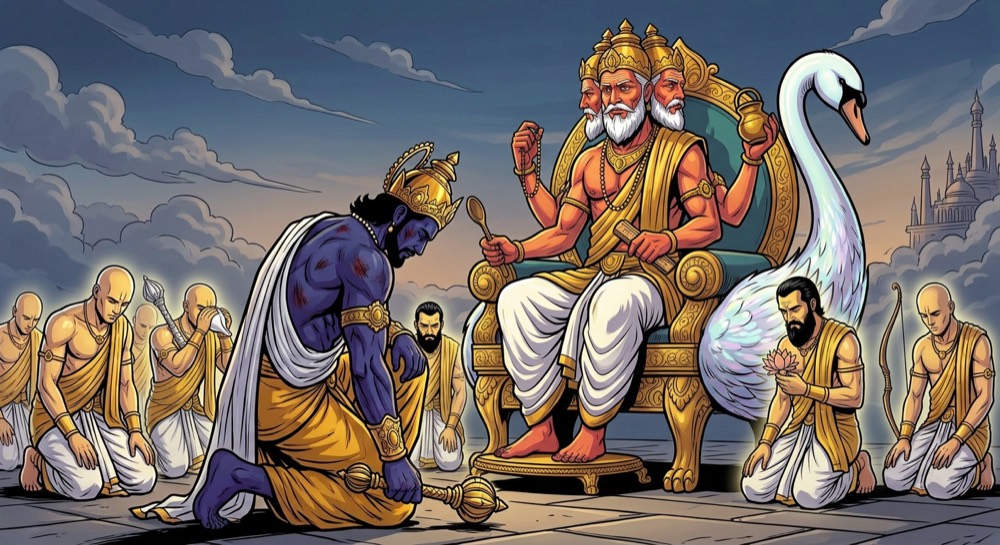
Read those two quotes again and the difference isn’t length. The second one never says what anyone means. It only says what you could point at.
What it looks like now
Every panel now carries a direction as well as a line, and the direction gets written as its own decision — because framing is where a comic gets its pulse. The same story holds its widest shot and its tightest, and the gap between them is doing as much work as the words:
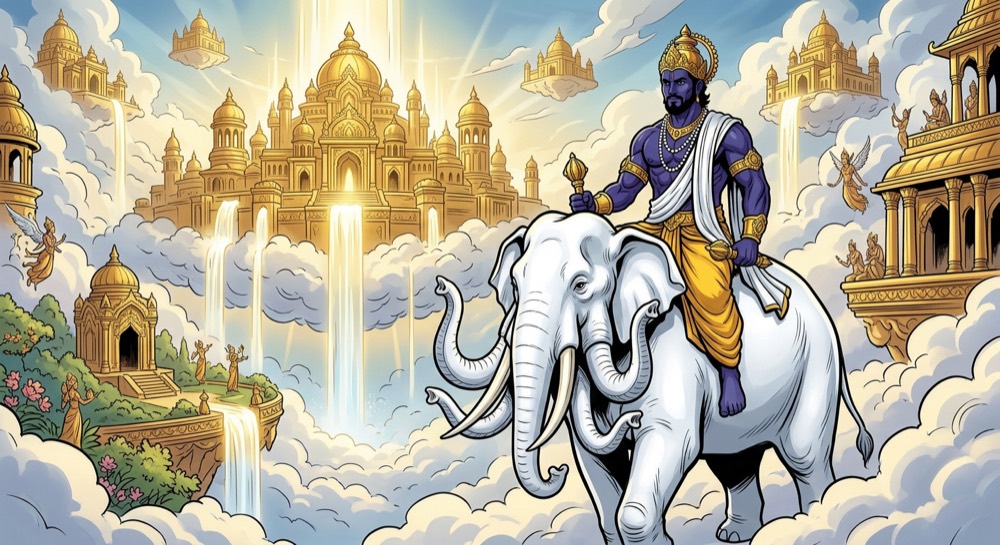 The widest in the story
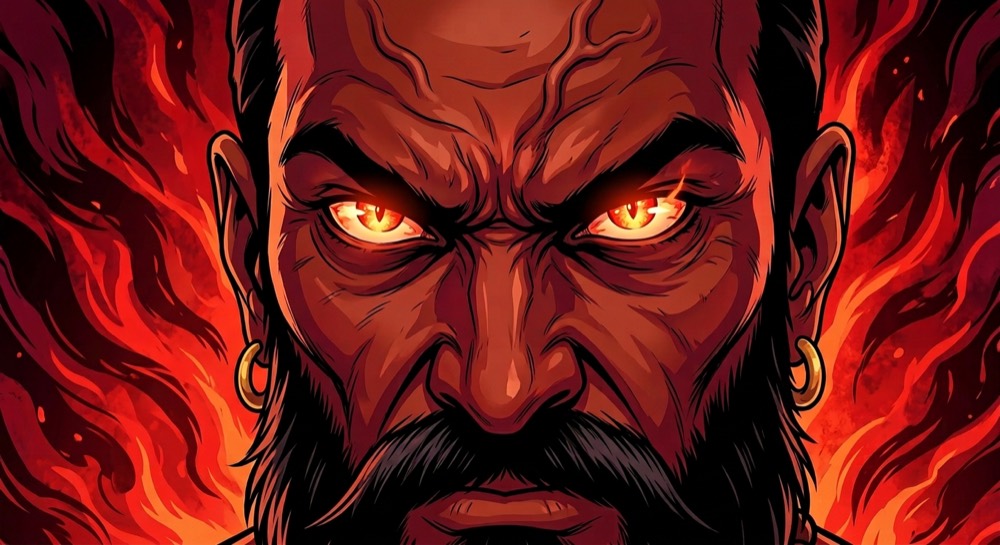 The tightest
What I’d taken for a drawing problem was a writing problem wearing a different coat. The step never refuses you: it will always return something plausible. So the work isn’t getting a picture out of it. It’s removing the arbitrariness — deciding, deliberately, the things it would otherwise decide for you.
Update log
- 2026-08-20 — Post #4. The document I didn’t know I was missing.