The last post ended with a story finally pinned down: this one, bounded here, in this version. Turning it into a script sounded like the easy part — same story, just cut into panels. The word doing all the work in that sentence turned out to be cut.

The assumption
I thought of scripting as reformatting. The hard decisions were behind me; what was left was chopping the story into scenes, scenes into panels, and adding the bits people say.
So the first scripts came out as prose with panel numbers on it. Read on their own, they were good. Genuinely good — well paced, nice lines, the right beats in the right order. Then I tried to draw one, and there was nothing to draw.
Where it broke
Every beat was too big.
A single panel was being asked to carry a whole paragraph of story: a sage arrives, offers a garland, the king takes it without looking, and an elephant tramples it underfoot. That’s four events. One picture cannot hold four events — a panel is a held instant, not a summary of one.
And an instant has one voice. Either someone is speaking, or something is being described to you, or a sound is landing. Ask a single moment to do two of those and it stops being a moment; it becomes a paragraph again, just with a border drawn around it.
So the failure wasn’t the writing. The writing was fine — that was the trap. Prose has no panel boundary, so nothing in it pushes back when a beat quietly grows too large. It reads beautifully right up until something has to be drawn.
The insight
The script’s real output isn’t the words. It’s the cut.
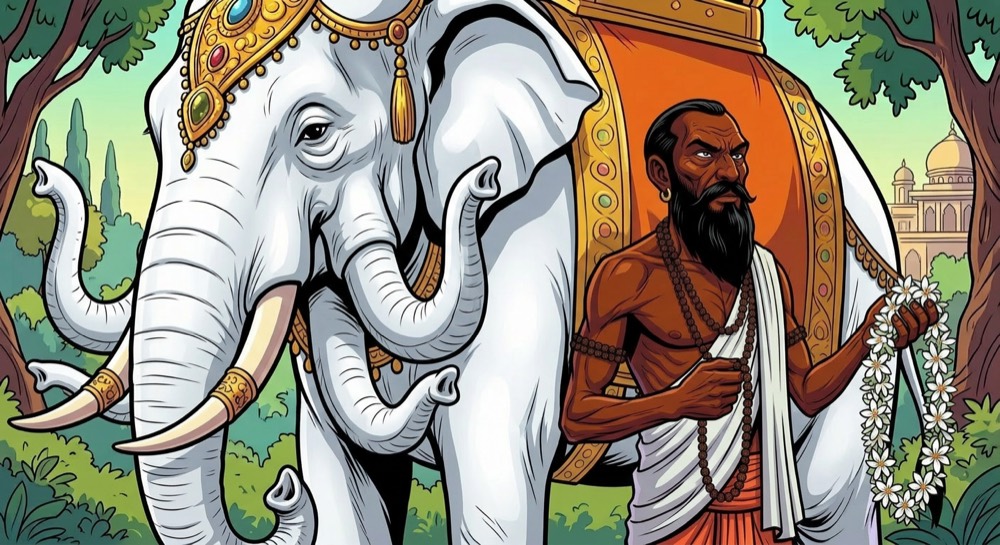 Someone speaks
 Something is described
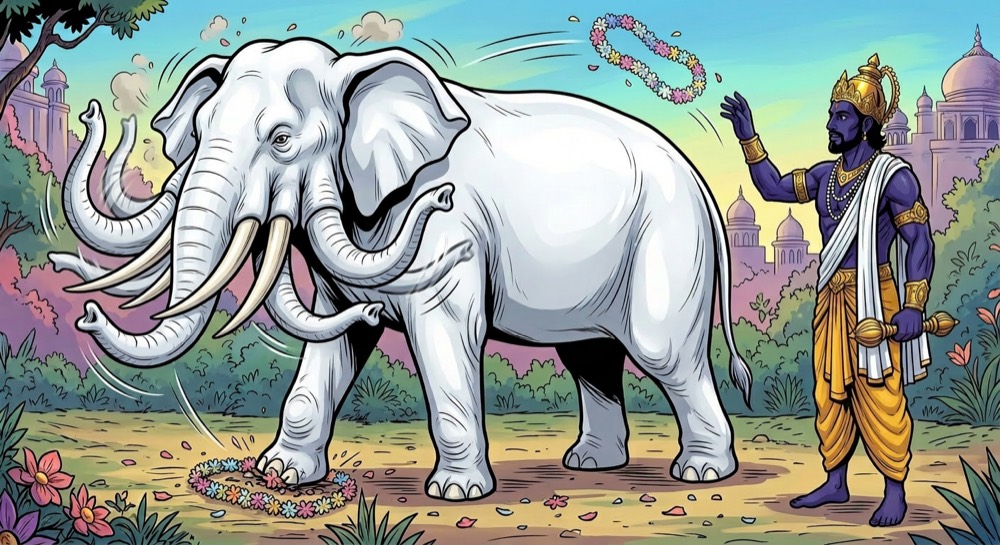 A sound lands
Deciding where one panel ends and the next begins is the job. Once the cut is right, the words are nearly obvious: this panel is a line somebody says, that one is a thing you need told, the next is a sound. Once the cut is wrong, no amount of good writing rescues it, because you’re writing captions for a picture that can’t exist.
That reframes what narration, dialogue and sound even are. They aren’t three ingredients to blend into each panel. They’re three kinds of moment, and the script’s job is to decide which kind each beat is — then give it a panel of its own.
What it looks like now
The step cuts first and writes second. It breaks the story into instants, decides what kind of instant each one is, and only then writes the single line that panel carries. A beat that wants two voices isn’t a crowded panel — it’s two panels that haven’t been separated yet.
Cut that way, the mix falls out on its own — and it’s lopsided in a way I didn’t plan:

What surprised me is how much this improved the prose, not just the structure. When each panel can hold one line, the line has to be worth its panel. The sprawling, reasonable, well-paced paragraphs were hiding how little each sentence was actually doing. Cutting finer didn’t constrain the writing; it exposed it.
Update log
- 2026-08-19 — Post #3. Also the first post in the shorter format, with a diagram. Reader feedback, fairly put: these were getting long.
- 2026-08-20 — Corrected. The original version of this post claimed panels got crowded by narration, dialogue and sound competing for the same space. That isn’t what happened, and checking the actual comics is what showed it — every panel carries exactly one voice, and always has. The real failure was coarser and more interesting: beats too big for any single picture. Rewritten around the cut, and the abstract diagram replaced with three real consecutive panels. Also added the pipeline map at the top, so it’s clear where this step sits.
- 2026-08-20 — Added the voice-mix bar. Narration doing sixty percent of the work was not a decision I made; it’s what fell out of cutting this way.