This is where it all started: I wanted to retell old myths as comics kids would actually reach for. The moment I decided it should be a series — not one book — everything about the problem changed.
The itch
The stories I grew up on are enormous, and most of them reach people in one of two shapes: dense text you have to work at, or the same small handful of famous tales told over and over. The rest — hundreds of them — sit just out of reach.
I wanted to give them a form people, especially children, would pick up on their own: pictures first, a clear thread, a page that pulls you to the next one. A comic. That part felt obvious.
The decision that mattered: a series, not a comic
The non-obvious choice was scope. It would have been easy — and satisfying — to make one beautiful comic. Pick a favorite story, illustrate it lovingly, ship it.
But one comic isn’t the point. The point is the whole tapestry: the big stories and the forgotten ones, the way characters recur and cross over, the sense that you could keep pulling threads for years. So the goal became a series — many, many stories, told with a consistent look and voice.
That one word — series — quietly rewrote the entire problem.
Why “series” is a different problem than “a comic”
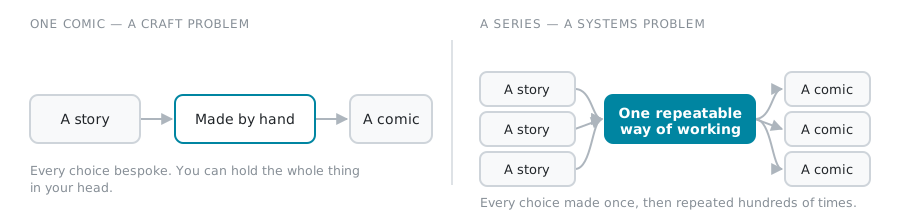
Making one comic is a craft project. You can hold the whole thing in your head. Every choice is bespoke: this character looks like this, this scene is lit like that, and you personally guarantee it all hangs together.
Making a series is a systems problem. You can’t hand-tune hundreds of stories one panel at a time and still finish this decade.
The moment you commit to volume, a pile of questions you never had to ask about one comic become the whole job:
- How does a character look the same across dozens of appearances?
- How do you keep the storytelling good when you’re not lovingly hand-crafting each one?
- How do you stay faithful to the source at scale, instead of quietly drifting?
None of those matter for a single comic. All of them are existential for a series. Choosing “series” is what turned a nice illustration project into everything this logbook is about.
What “starting” actually looked like
The first real step was small and concrete: take one tradition to begin with, pick a canonical story, and turn it into an illustrated comic — a script broken into scenes and panels, with art to match. Nothing fancy. Just proof that a single story could go from “text somewhere” to “a comic you can read.”
It worked. And the instant it worked, the series ambition sent the bill: every problem I’d waved away — consistency, quality, faithfulness, and later narration and video — lined up and started knocking.
That’s what the next posts are about. This one is just the starting line: an illustrated comic, and the decision to make it a series that made everything after it hard in the best way.
Update log
- 2026-07-24 — First post in the series-about-the-series. If the list of problems above looks suspiciously like a table of contents… that’s because it is.
- 2026-08-20 — Added a diagram of the choice this post is actually about: one comic made by hand, against many made the same way.